Danger zone food temperatures are the range where bacteria can grow quickly on many foods. In Australian kitchens, they matter because busy prep, warm weather, and long service windows can push food into risky ranges without anyone noticing.
This guide explains what the danger zone is, why it matters, and how Australian food businesses and home cooks can control it with simple, repeatable checks.
What are danger zone food temperatures in Australia?
Danger zone for food temperatures are typically between 5°C and 60°C, where food poisoning bacteria can multiply fast. If food sits in this band for long enough, the risk of illness rises sharply.
In practice, Australian kitchens aim to keep cold food at or below 5°C and hot food at or above 60°C to stay out of the danger zone.
Why do danger zone food temperatures matter so much?
Danger zone food temperatures matter because bacteria can double rapidly in warm conditions, especially in protein-rich and moist foods. The longer food stays in this range, the more likely it becomes unsafe, even if it looks and smells fine.
They also matter because many outbreaks start with common steps like cooling, reheating, transport, or a fridge running a few degrees warm.
Which foods are most affected by danger zone food temperatures?
Danger zone food temperatures affect potentially hazardous foods most, particularly those that support bacterial growth. These foods usually have moisture, nutrients, and a neutral enough acidity level for microbes to thrive.
Common Australian examples include cooked rice, pasta, meat, poultry, seafood, eggs, dairy, cut fruit, and prepared salads, plus foods like gravy, soups, and casseroles.
How long can food sit in danger zone food temperatures?
Food should spend as little time as possible in danger zone food temperatures, because time is the multiplier. Many Australian kitchens manage this by tracking how long food is out during prep, display, delivery, and service.
If food has been sitting in the danger zone for an extended period, it should be treated as unsafe rather than “rescued” by re-cooling or re-heating.
What temperatures should fridges and freezers be set to in Australian kitchens?
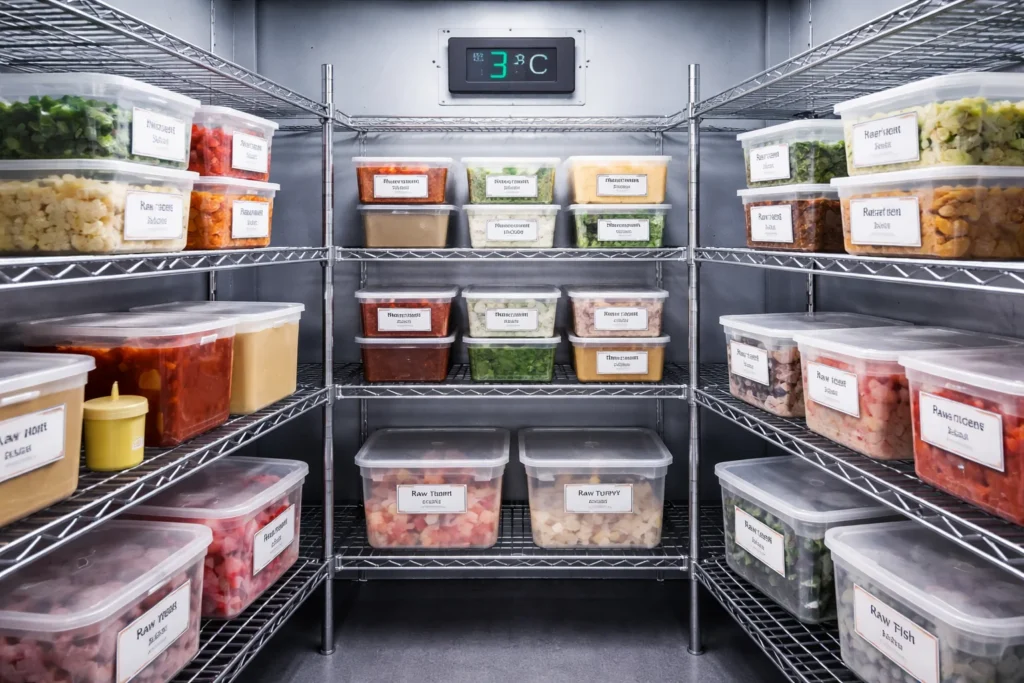
To avoid danger zone food temperatures, fridges are commonly kept at or below 5°C, with many kitchens targeting around 3°C to allow for door openings and load changes. Freezers are typically kept frozen solid, commonly at or below -15°C to -18°C for reliable storage.
They should also verify the actual air and product temperatures with a thermometer, since a dial setting is not proof of performance.
What hot holding temperatures keep food out of the danger zone?
Hot holding should keep food at or above 60°C to stay out of danger zone food temperatures. That applies to bain-maries, heat lamps, pie warmers, hot display units, and pass benches during service.
They should remember that hot holding is not the same as reheating, and units often hold poorly if trays are shallow, lids are off, or food is stirred infrequently.
What internal cooking temperatures are practical for safety?
Cooking is one of the most reliable controls against danger zone food temperatures because it reduces bacteria to safer levels when done properly. The key is checking the thickest part of the food with a clean probe thermometer.
Many Australian kitchens use targets such as: poultry cooked thoroughly, minced meats cooked through, and reheated foods brought back to steaming hot. When in doubt, they should use thermometer checks rather than colour or texture.
How should they cool food quickly to avoid danger zone food temperatures?
Cooling is a high-risk step because large pots and deep trays can sit in danger zone food temperatures for hours. The safest approach is to cool food fast and shallow, then refrigerate promptly once it drops.
They can portion food into smaller containers, use shallow trays, ventilate briefly, and place containers where cold air can circulate. Ice baths, blast chilling, and cooling paddles can also help in busy Australian kitchens.
How should they reheat food safely without lingering in the danger zone?
Reheating should be fast so food does not spend long in danger zone food temperatures. Slow warm-ups in bain-maries or warmers are a common mistake because they heat too gently and unevenly.
They should reheat quickly using stovetops, ovens, microwaves, or combi ovens, then move food into hot holding above 60°C. Stirring and turning during reheating helps remove cold spots.
How can they manage buffets, displays, and catering where food sits out?
Buffets and catering are where danger zone food temperatures can sneak in because food is often displayed for convenience, not control. They should plan for shorter service windows, smaller replenishment batches, and clear time tracking.
Cold displays need enough refrigeration capacity to keep food at or below 5°C, and hot displays must hold above 60°C. If conditions cannot be maintained, they should swap to timed service and discard policies.
What thermometer practices reduce risk the most?
Thermometers reduce risk because they replace guesswork with proof, which is essential when controlling danger zone food temperatures. A probe thermometer, a fridge thermometer, and basic logging cover most needs.
They should calibrate probes when required, sanitise between uses, and check: incoming deliveries, fridge temperatures, hot holding units, cooling foods, and reheats. A simple routine prevents gaps during peak periods.
What are common Australian kitchen mistakes that push food into the danger zone?
Many issues happen during the busiest moments, which is exactly when danger zone food temperatures become easiest to miss. The most common pattern is good cooking followed by poor cooling, weak cold storage, or slow reheating.
Typical mistakes include overfilling fridges, stacking hot containers straight into cool rooms, relying on bain-maries to reheat, leaving food on benches during prep, and transporting catering without insulated equipment.
How do they build a simple daily checklist to control the danger zone?
A checklist works because it turns danger zone food temperatures into a few non-negotiable checks. It also helps casual staff and split shifts keep standards consistent across the week.
A practical daily routine can include: record fridge temps at open and mid-shift, verify hot holding temps during service, probe-test one cooling batch per shift, confirm reheats are steaming hot before hot holding, and document any corrective actions like discarding or rapid chilling.
What should they do if food enters danger zone food temperatures?
If food enters danger zone food temperatures, they should act based on time and risk, not hope. The safest option is often to discard, especially when the time out is unknown or the food is high-risk.
If they can prove the time and control the process, they may be able to correct it by rapidly returning food to safe cold holding or hot holding, but only if it has not been sitting too long. When unsure, they should treat it as unsafe.
How can they explain danger zone food temperatures to staff in one minute?
They can explain danger zone food temperatures as a simple rule: keep cold food cold (≤5°C), keep hot food hot (≥60°C), and minimise time in between. That framing is easy to remember during service and prep.
They should also link the rule to real tasks: quick cooling, fast reheating, smaller batches, covered storage, and thermometer checks at the points where food changes temperature.
What’s the simplest takeaway for Australian kitchens?
Danger zone food temperatures are best controlled by setting firm cold and hot targets, then managing time whenever food is in transition. If they focus on cooling, reheating, and storage checks, most everyday risks drop fast.
With consistent thermometer use and a short checklist, Australian kitchens can keep food out of the danger zone and keep service moving without cutting corners.
Danger zone food temperatures in Australia typically range between 5°C and 60°C. Within this temperature band, bacteria can multiply rapidly, increasing the risk of foodborne illness. To maintain food safety, cold foods should be kept at or below 5°C, and hot foods should be maintained at or above 60°C to prevent bacterial growth.
Controlling danger zone food temperatures is crucial because bacteria double rapidly in warm conditions, especially in protein-rich and moist foods common in Australian kitchens. Prolonged exposure to these temperatures increases the risk of food poisoning, even if the food appears and smells normal. Many outbreaks originate from improper cooling, reheating, transport, or slightly warm refrigeration.
Potentially hazardous foods that support bacterial growth are most affected by danger zone temperatures. These include cooked rice, pasta, meat, poultry, seafood, eggs, dairy products, cut fruit, prepared salads, gravy, soups, and casseroles. Such foods have moisture and nutrients that enable microbes to thrive if not properly stored.
Food should spend as little time as possible between 5°C and 60°C since bacterial growth accelerates over time. Australian kitchens often track how long food is exposed during preparation, display, delivery, and service. If food has been in the danger zone for an extended period, it should be considered unsafe and discarded rather than relying on re-cooling or reheating to make it safe.
To avoid danger zone temperatures, fridges in Australian kitchens are commonly set at or below 5°C—often around 3°C to compensate for door openings and load variations. Freezers should be maintained frozen solid at or below -15°C to -18°C for reliable storage. It’s important to verify actual air and product temperatures with thermometers rather than relying solely on dial settings.
Safe cooling involves rapidly reducing food temperature by using shallow containers, portioning into smaller batches, ventilating briefly before refrigeration, and employing tools like ice baths or blast chillers. For reheating, food should be heated quickly using stovetops, ovens, microwaves or combi ovens to reach steaming hot temperatures above 60°C promptly; slow warming methods like bain-maries can cause uneven heating and prolong time spent in the danger zone. Stirring during reheating helps eliminate cold spots.